
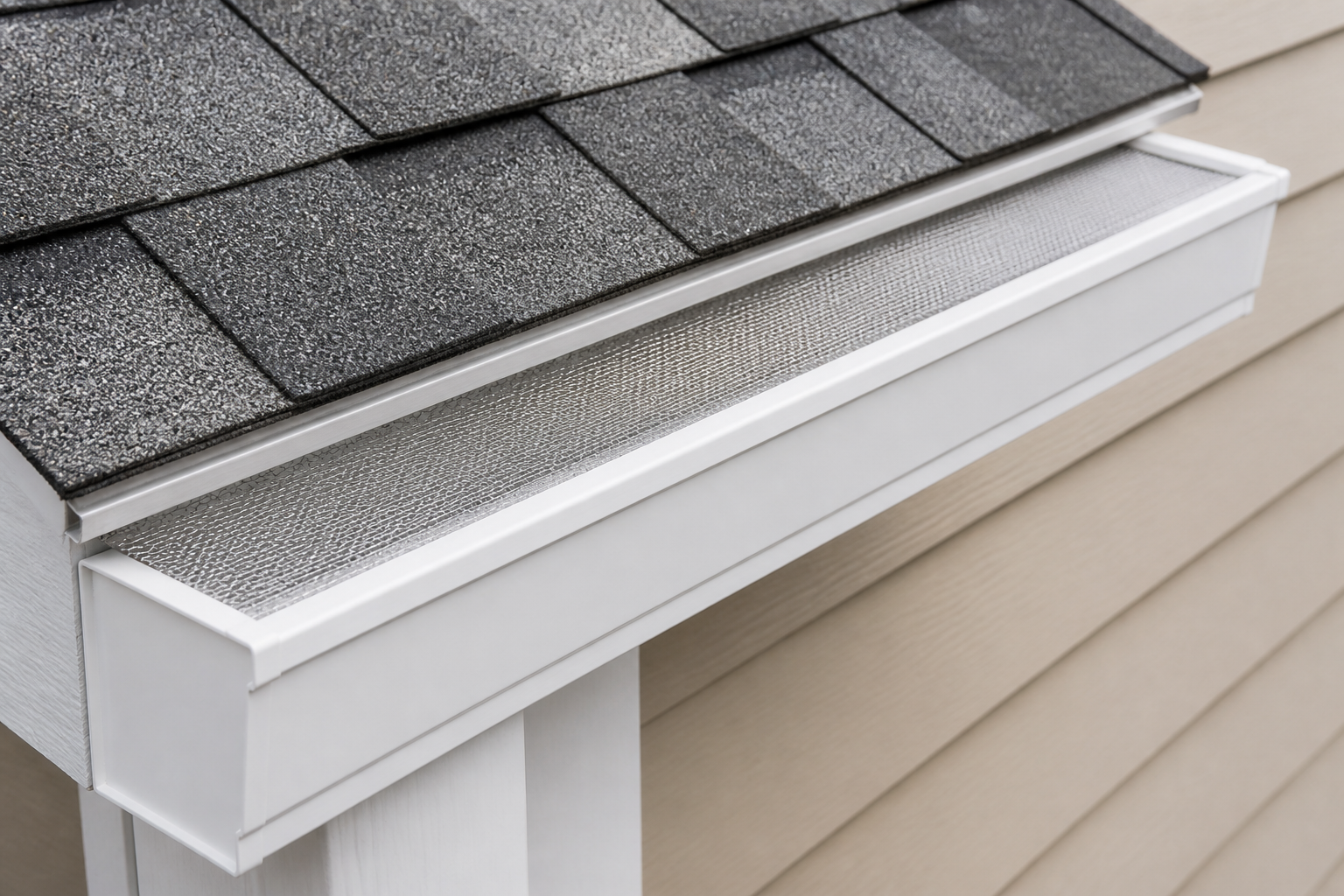
Dayton receives 41.33 inches of precipitation annually (NOAA USW00093815, 1991–2020 normals), with spring months among the heaviest. Sectional gutters — prefabricated lengths joined with connectors — tend to fail at seams under that sustained load. Seamless installation removes those joints along each run, leaving connections only at inside/outside corners and downspout outlets.
How on-site extrusion works
A gutter machine pulls aluminum coil through forming rollers at your property, producing a custom-length channel matched to each roof edge. The installer measures each run, accounts for pitch, and cuts the extruded profile to fit. Hangers are spaced per manufacturer specs — typically every 24 to 36 inches — and screwed into fascia or rafter tails.
Most Dayton installs use 0.027-inch or 0.032-inch aluminum coil in standard K-style or half-round profiles. Color options are baked-on enamel finishes that resist UV fading through hot summers — Dayton averages 15.6 days at or above 90°F annually — and cold winters with 109.8 days where the minimum falls to 32°F or below.
Seamless vs sectional for Dayton homes
With 67 percent of Dayton housing units built before 1960 and a median year built of 1951, many homes still carry second- or third-generation sectional systems. These aging channels often show separated joints, pulled hangers, and rust at connection points. Full gutter replacement with seamless aluminum addresses the root cause rather than patching individual leaks.
Industry pricing puts seamless aluminum installation at $12 to $25 per linear foot (HomeGuide, 2026). The premium over sectional material reflects equipment and skilled labor, not just raw material cost. For whole-home totals, see our Dayton gutter replacement cost breakdown.
Sizing for Dayton rainfall
Five-inch K-style gutters handle the majority of residential roof areas in this market. Six-inch profiles carry roughly 40 percent more volume and suit large roof planes or short runs that collect drainage from multiple slopes. Six-inch sizing is a cloudburst-capacity argument — not a code requirement in Dayton.
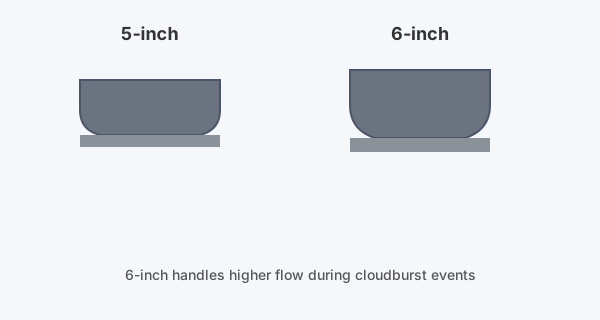
Dayton records 9.4 days per year with at least one inch of rainfall. During those events, properly pitched seamless channels move water to downspouts without overflowing. Pitch should be at least one-quarter inch per ten feet toward the nearest outlet.
Fascia, paint, and EPA considerations
The EPA classifies screw-on seamless gutter installation that does not disturb existing fascia paint as a minor repair in many circumstances. However, fascia on pre-1978 homes may contain lead-based paint. If boards need replacement or sanding, Renovation, Repair, and Painting (RRP) rules apply. Your installer should assess fascia condition during the quote visit.
Historic districts in Dayton may require matching gutter profiles through a minor Certificate of Appropriateness — typically same-day approval with no fee at (937) 333-4271. Copper is not required city-wide, though it remains an option for architectural compatibility. Material details are on our Dayton gutter materials page.
Best timing for seamless install
Installers generally recommend scheduling between May and September, avoiding December through February when frozen fascia and cold sealant complicate field work. The last spring freeze at 50 percent probability falls around April 16, with 90 percent by May 3 (NWS ILN). Wettest months are April and May, so completing install before peak spring rainfall protects your home through the heaviest season.
Dayton Gutter Installation performs seamless extrusion on site. Return to the Dayton gutter overview or call for a quote.
Get a seamless gutter install quote for your Dayton home.
Call (937) 977-1925